How it works
AI agent security, built to actually get used.
One SDK. Two lines of code. Every layer active immediately — no configuration files, no YAML, no manual setup.
Getting started
Three steps. That's it.
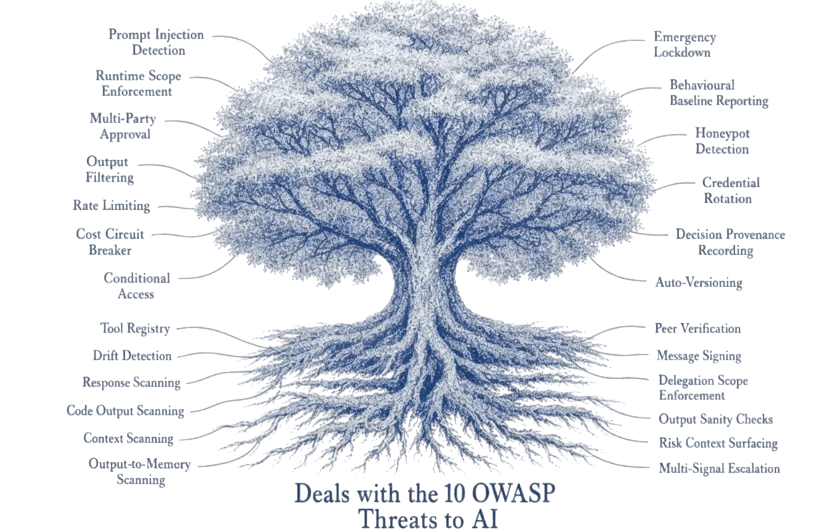
Defense in depth
Not a wall. A sequence.
Every layer in Altheris is a checkpoint, not a barrier — and an attacker has to clear every one of them, in order, to get anywhere. Hijack a goal, and scope enforcement decides whether that goal ever reaches a tool. Reach a tool, and identity checks, drift detection, and code scanning decide whether that call ever executes. There's no shortcut around the sequence — each layer only matters if every layer before it already failed.
That sequence is also the trap. Behavioural baselines and honeypot detection are watching for exactly the kind of pattern an attack makes while working through those checkpoints. Long before an attacker reaches the end of the chain, the SDK has usually already flagged the attempt — and the moment it does, the account owner can trigger an emergency lockdown that stops every agent instantly. An attacker isn't just fighting one layer. They're racing the SDK's ability to notice.
Comparison
Where Altheris fits.
There are other ways to secure AI agents. Here's how Altheris is different.